Molokhia (ملوخة) is an iconic dish prepared with dark leafy greens of the same name. You can find this dish in kitchens and restaurants throughout North Africa, the Levant, and beyond. Its preparations are as varied as they are rich: some like the leaves chopped while others keep them whole. Some serve the dish with wedges of lemon while others prefer the zing of quick-pickled onions. Over the last century, molokhia has been projected onto national identities — the Tunisian preparation, for example, is known for its use of dried, ground molokhia leaves stewed with a meat broth for hours, while in Egypt you typically find finely chopped molokhia leaves cooked as a soup and finished with a sizzling blend of garlic and coriander called tiqlayye (تقلاية). In the Levant, some Syrians swear by whole leaves to keep the molokhia from getting too slimy. But how accurate are these national categories? And do they elide more than they reveal?
Part 1: Molokhia and National Identities
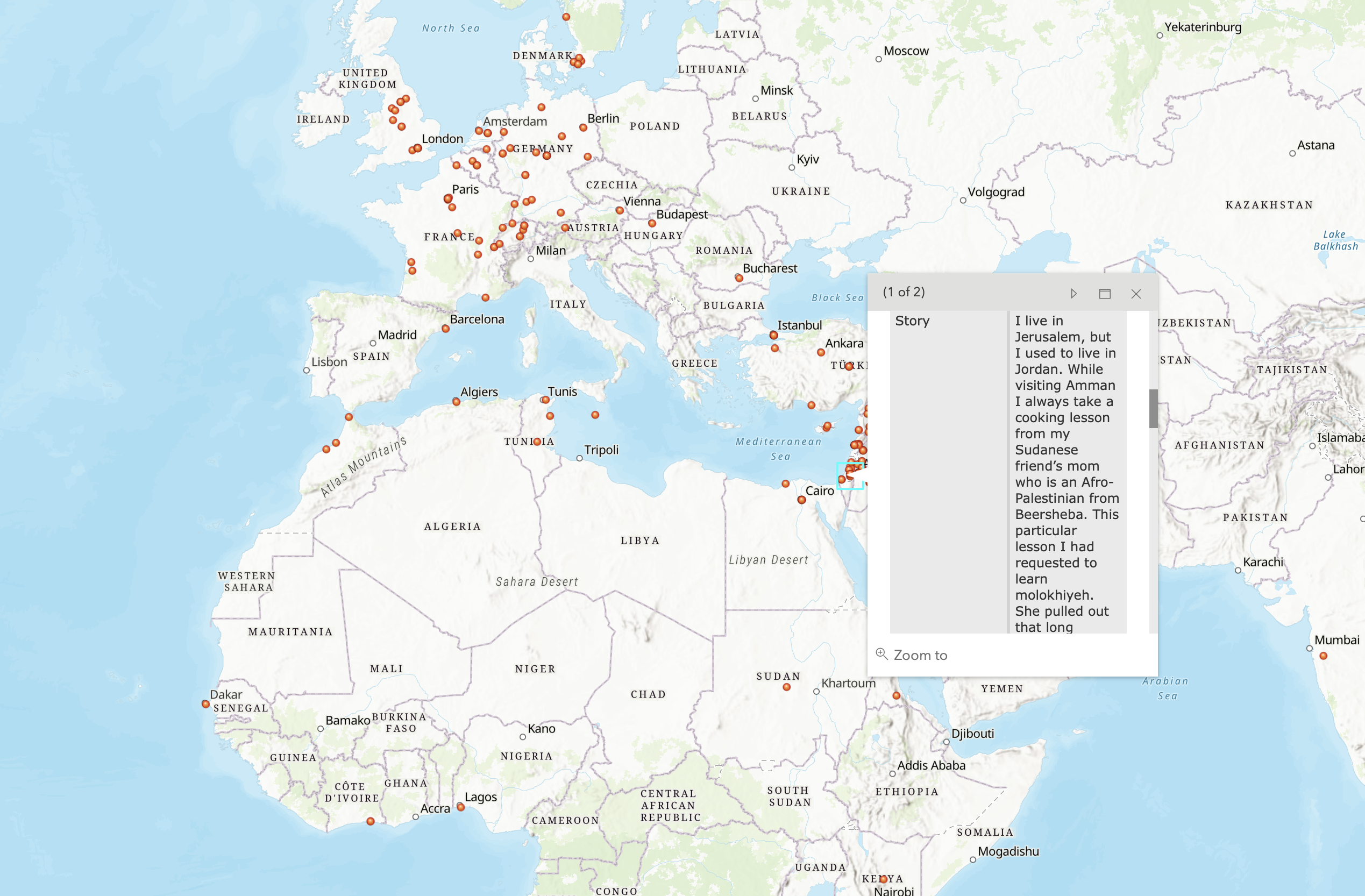
The first part of my molokhia project explored the national identities that have been shaped by and projected onto different preparations of molokhia. I started by hosting a molokhia survey with both quantitative and qualitative questions about this beloved dark leafy green. With results pouring in from all around the world, I decided to visualize these stories as part of a visual map that speaks to the global reach of this tasty dish.
Part 2: The Politics of Slime
Being a botanical sibling of okra and a member of the mallow (scientific name: malvaceae) family, molokhia leaves are mucilaginous. In fact, the more you chop them, the more “mucilage” they let out. Molokhia lovers have strong feelings about this, which piqued my interest and inspired a second field of inquiry: the politics of slime. Some people lean into molokhia’s sliminess while others do what they can to minimize the “snot-like” substance. For the second part of my molokhia project, I researched historical references to this leaf, reading Arabic manuscripts from as far back as the 9th century, and trying to determine if and when writers began describing the slimy properties of molokhia as something that ought to be avoided. For this research, I built on theories of “taste” by renowned sociologist Pierre Bourdieu and the arguments Siddhartha Mitter makes in his essay, Free Okra, which he published in Oxford American (Issue 49, Spring 2005). I presented my findings at the Middle East Studies Association Annual Meeting in 2022, Denver, Colorado (MESA 2022 Program).
Part 3: Molokhia or Molokia (ملوخية أم ملوكية)?
Throughout my deep dive on molokhia, I heard a lot of people refer to the dish as a “royal,” linking the name, molokhia (with a “kh” sound), to molokia (with a “k” sound). The root for royal in Arabic is m-l-k (م.ل.ك.), so many people attributed a royal reputation to this dish. I wanted to find out, is this true or is this folk etymology? For the third part of my research, I scoured my references for clues that point to the origins of this reference. I presented my findings in a linguistics course I took at Middlebury’s language schools in the summer of 2023.
Related Molokhia Publications/Appearances
- Molokhia Archive: A global, collaborative archive dedicated to molokhia
- Tabletop Debates: reflections on molokhia, identity, and forks vs spoons (Center for Contemporary Arab Studies, December 2022)
- Molokhia: How a humble green leaf both divides and conquers the Middle East (Middle East Eye, February 2022)
- Al Jazeera Mubasher Interview on National Cuisine (February 2023)
- Molokhia Presentation at the TEDinArabic Summit in Doha, Qatar, (March 2023)